History  (Page 1 2 3)
St Paul's was one of the churches built after the Industrial Revolution to cope with the expansion of London's population and to provide for their educational and administrative needs.

The industrialisation that took place in England in the early 19th century heralded social and cultural changes. One of these was the declining role and influence of the established church. Industrialisation brought about a shift in population from rural to new urban areas. This was not accompanied by an increase in church building. There was one parish church in Sheffield, for example, which in 1615 served a population of 2,207. In 1736 there was still only the one parish church, which now had to cater for a population of 9,965. By 1821, the town's population had grown to 65,275 but by this date only two further churches had been built.

The post-medieval village or town had been dominated by its church - both physically and symbolically; usually built on a commanding position within the parish where it symbolised the authority of the established church.

The parochial system normally served small village communities of 'lowland' rural England. The system broke down in the new urban areas that grew within old parish boundaries. As industrialisation continued at a rapid pace in the aftermath of the Napoleonic Wars, the concentration of population accelerated in the industrial towns.

Where the Church of England responded only slowly to the change and growth of population, other churches and movements grew to fulfil spiritual needs. Growing toleration allowed non-conformist churches to expand outside London, in Islington for example, and to take advantage of the new socio-economic climate. Within those 90 years the Church had lost a monopoly of English religious practice and became a minority religious establishment. The situation had been compounded during the years of economic depression following Waterloo - an age of widespread disturbance, threatened revolution and distress in England, with extensive poverty in both the countryside and towns.

The Church of England slowly realised the need for a massive programme of church building. In the wake of Waterloo, a movement was founded to lobby for the building of new churches to commemorate victory. Late in 1815 it was calculated that in the 50 parishes in or near London, there were not enough Anglican places of worship to accommodate even one tenth of the higher classes in society. The parish system represented the only framework for local civil administration. It was realised that it could not be undertaken by private subscription alone, but only by parliamentary legislation.

The movement gathered momentum over the next two years and a limited programme of church building was outlined in the Prince Regent's speech at the beginning of 1818. On 6th February, at a public meeting chaired by the Archbishop of Canterbury, the Church Building Society was launched following a motion proposed by the Duke of Northumberland. A 36-member committee was appointed which included eight future Church Building Commissioners.

The newly formed Church Building Society promptly lobbied parliament for a more far-reaching church building programme than that which had been included in the Prince Regent's speech. The Church Building Society's efforts were successful and parliament passed the first Church Building Act later that year, voting £1 million for the construction of new churches.

The passing of the Act opened a new chapter in the history of church building in England, which MH Port in his book Six Hundred New Churches, describes as one of the four major church-building episodes since the close of the Middle Ages. The Act became popularly referred to as the Million Act, and the churches built under it were known as 'Waterloo', 'commissioners'' or 'million' churches.

It was initially thought that the 1 million would build 100 new churches, and with the aid of subscriptions a further 50 or even 100 additional churches could be built. Populous parishes of at least 4,000 inhabitants were targeted where the existing parish had accommodation for fewer than 1,000 worshippers.

In 1824 the government received a windfall when Austria unexpectedly repaid a war loan of £2 million. From this sum £500,000 was voted to be added to the funds of the Church Building Society. The Society became the Incorporated Church Building Society by an act of parliament in 1826. The Commissioners were also empowered to raise further sums by accumulating common interest and loan interest on the sums they administered, and by the reclamation of duty paid on materials used in the building of the churches. By this time the funds available to both the Commissioners and the Society were virtually exhausted. A further Act was passed which abolished the exercise of raising funds in churches for disasters such as fires.

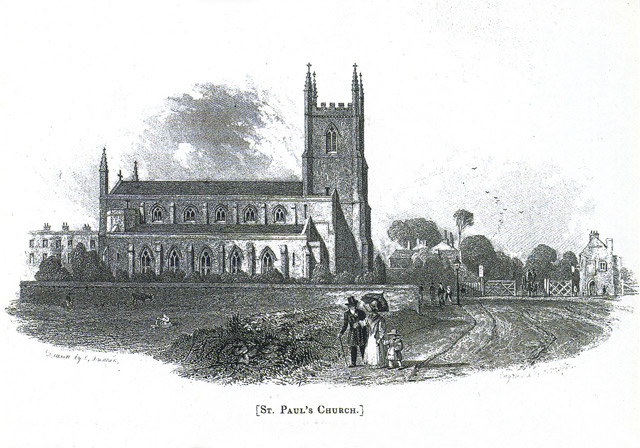
It was under the second Church Building Act that St Paul's Islington was built, together with the two other Islington new churches, in Cloudesley Square and St Johns, Holloway.

The commissioning of so many new churches did provide an ideal opportunity for the construction of churches with contemporary architectural designs. However, budget constraints and the importance of providing optimum space deterred innovative schemes.

The million churches illustrated how the Gothic tradition had remained the style associated with church architecture, at a time when British architecture reflected a variety of styles, dominated by neoclassicism and the Greek revival. They are also interesting for revealing a strong distinction between the styles of churches built in the more fashionable city centres - particularly London - and those elsewhere. In the provinces the new churches tended to be Gothic, but in London the first of the million churches were almost exclusively neo-classical and Greek revival. Islington at this date was not part of London.

The architects who assisted the commissioners were all prominent neo-classicists: John Nash, John Soane, Robert Smirke, Thomas Hardwick and William Wilkins. Of the work of these architects, one of the best examples is All Souls, Langham Place (Nash, 1822-4) with its circular, spired vestibule, which formed a key element of Nash's Regents Park scheme. Sir Robert Smirke built four churches outside London, three of which are Grecian and located in towns, namely Bristol, Salford and Chatham. The fourth, at Tyldesley, Lancashire, was Gothic and served an area consisting of coal mining and industrial hamlets.

Charles Barry was the youngest of the Commissioners' architects, chosen by competition. All his church designs were in Gothic. It was unusual at this time to find a young rising star designing in the Gothic style, but the young Barry was familiar with the work of Britton & Carter and the growing antiquarian movement.

Port identifies the existence of some local schools of design, in particular those of the old West Riding of Yorkshire in the 1820s. Here the churches exhibit close similarities that can be categorised in two styles, the Lancet and the Decorated. St Pauls is a mixture of decorated and the later perpendicular - considered in 1828 to be the 'National Style'!

By 1856 the Incorporated Church Building Society had funded the construction of 615 churches. The costs of these new churches amounted to over £3 million; £1,675,000 raised by the Society and £1,675,000, by the Church Commissioners.

In the middle 20 th Century St Pauls was regarded as a drab and incoherent attempt to revive the Parish church tradition. At the beginning of the 21 st Century it can be seen as the generator of a new social order and key monument in the revival of the Gothic style.
Building Photographs
St Pauls Steiner Project